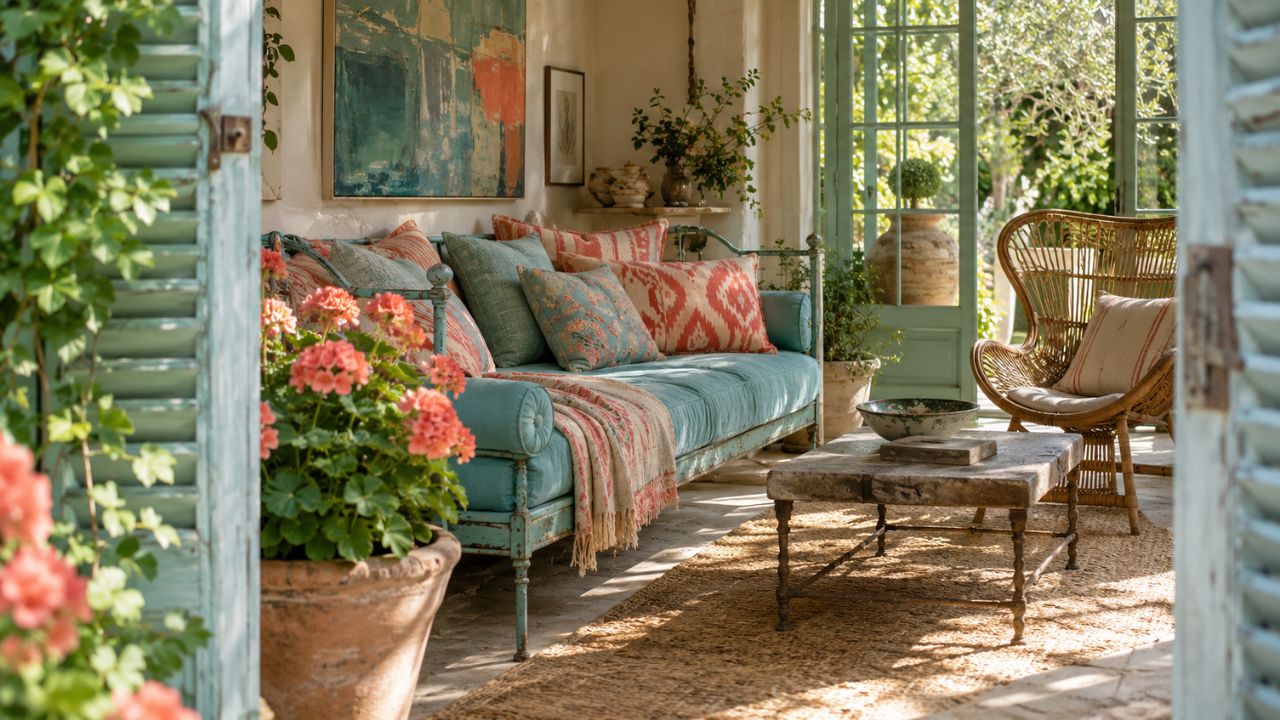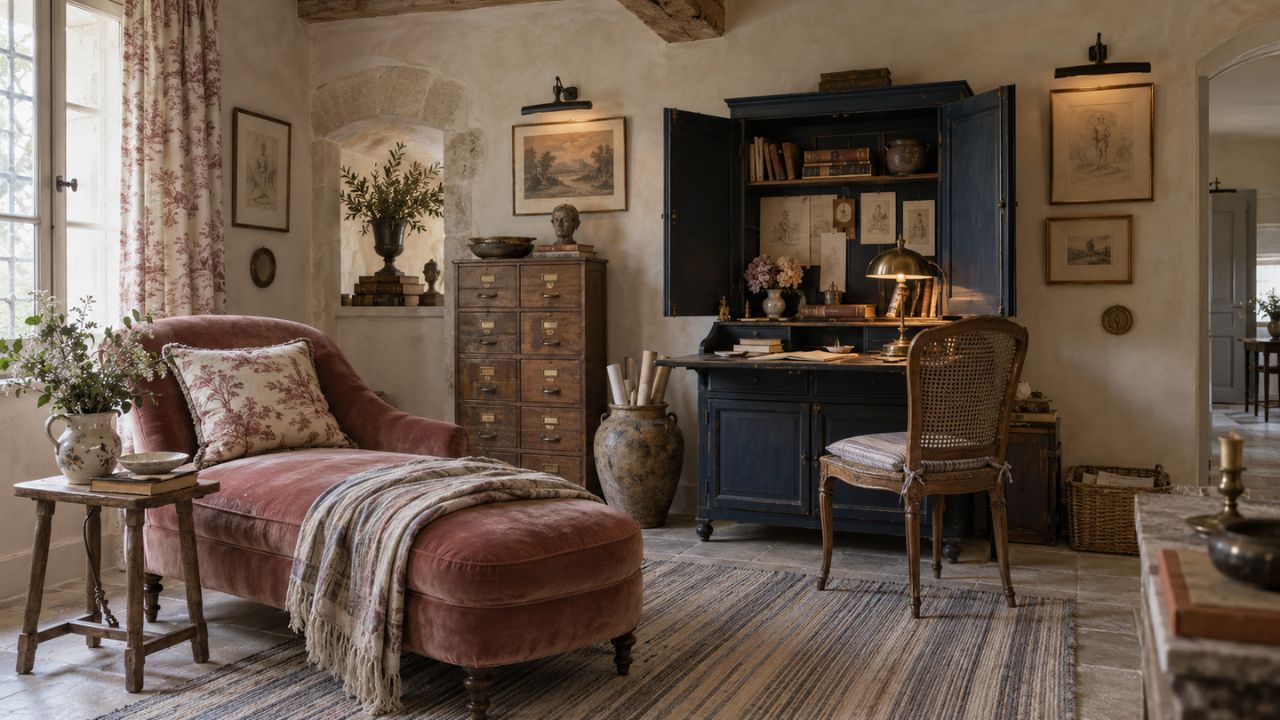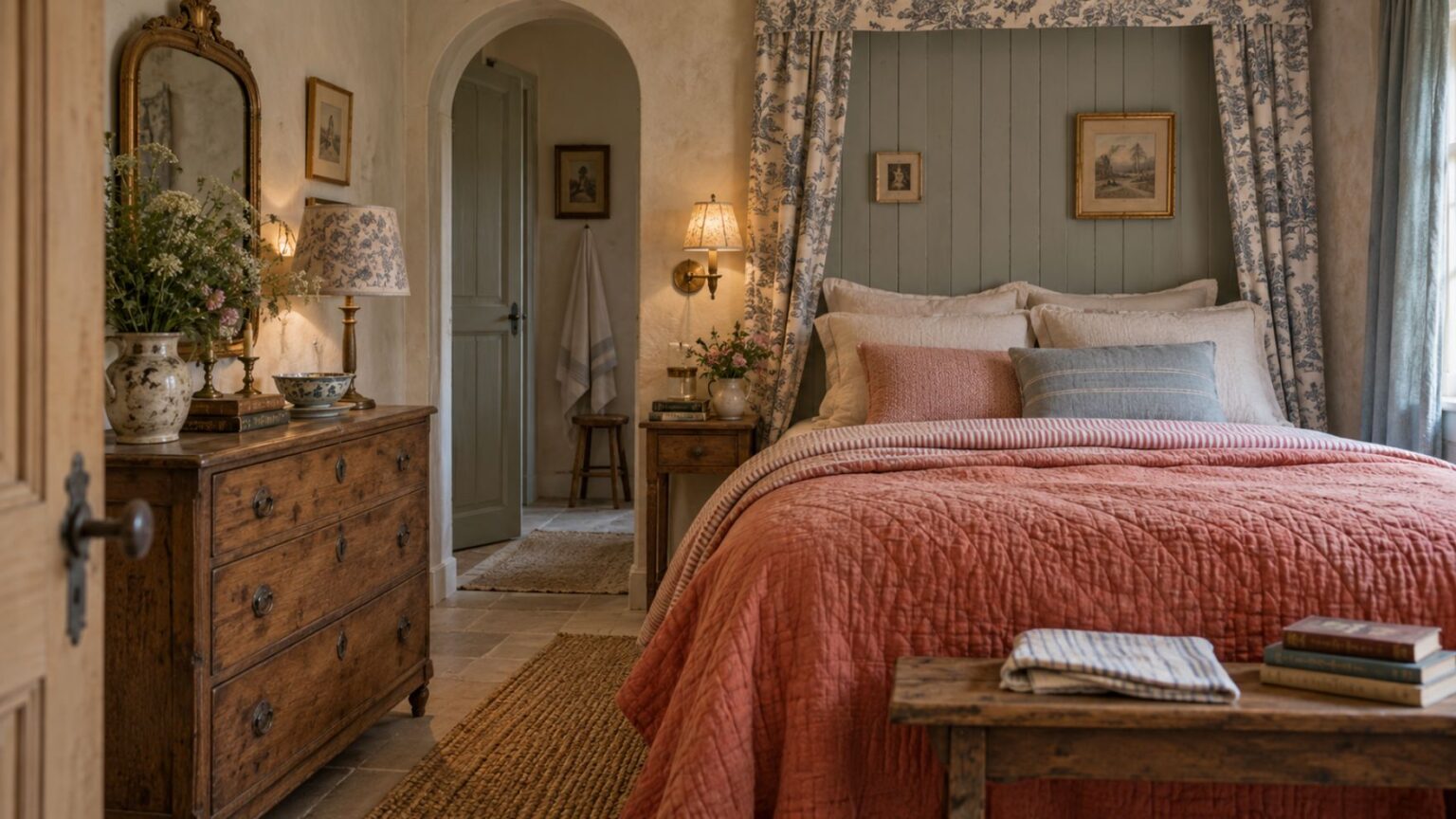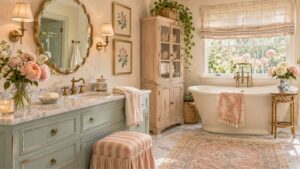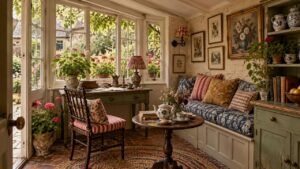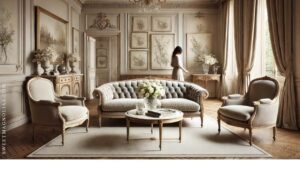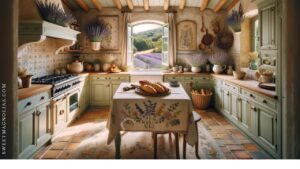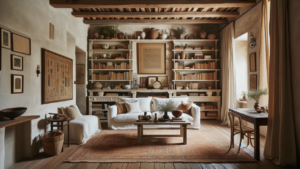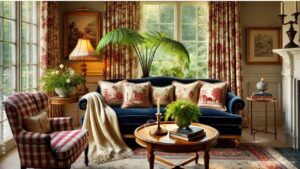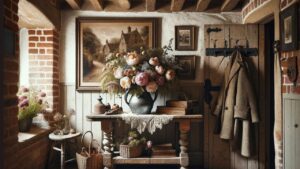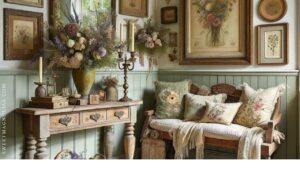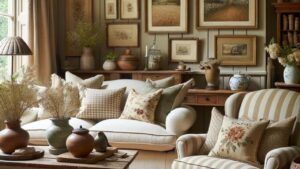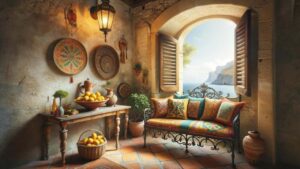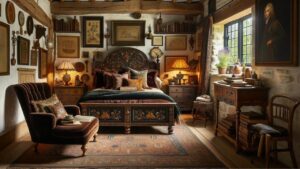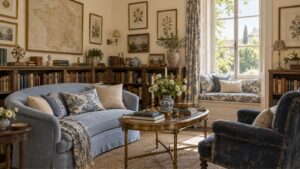
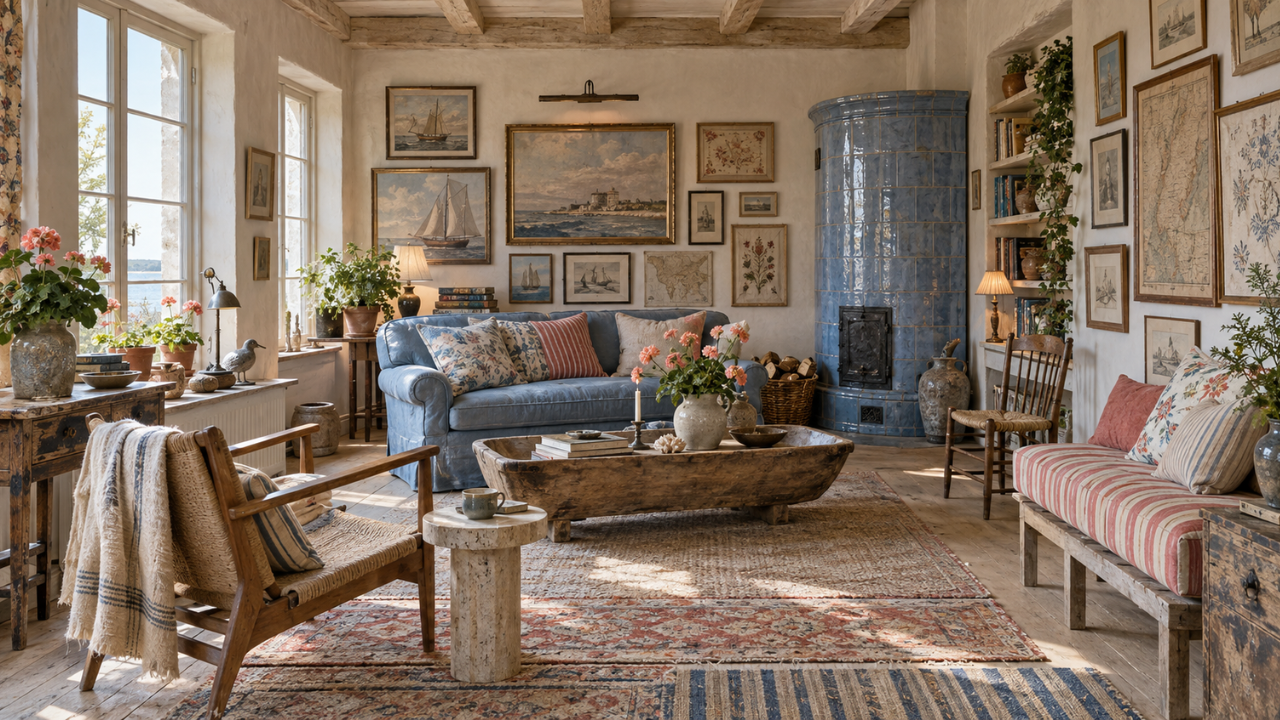
Cottage style homes have a wonderful way of making walls feel like part of the story.
Instead of relying on one perfectly placed piece of artwork, cottage wall decor can grow slowly through paintings, botanical prints, family photographs, decorative plates, mirrors, embroidery, baskets, old maps, and little treasures gathered over time.
That is also why a gallery wall feels so natural in a cottage. It does not have to be perfectly symmetrical or filled with matching frames. It can be romantic, slightly unexpected, and deeply personal.
But framed art is only one possibility.
From vintage plate displays and botanical collections to antique mirrors and textile art, there are many ways to decorate cottage walls while keeping the room warm, relaxed, and full of character.
Here are 15 cottage wall decor ideas to inspire your own home.
1. Create an English Countryside Gallery Wall
An English countryside gallery wall is a natural starting point for cottage style homes.
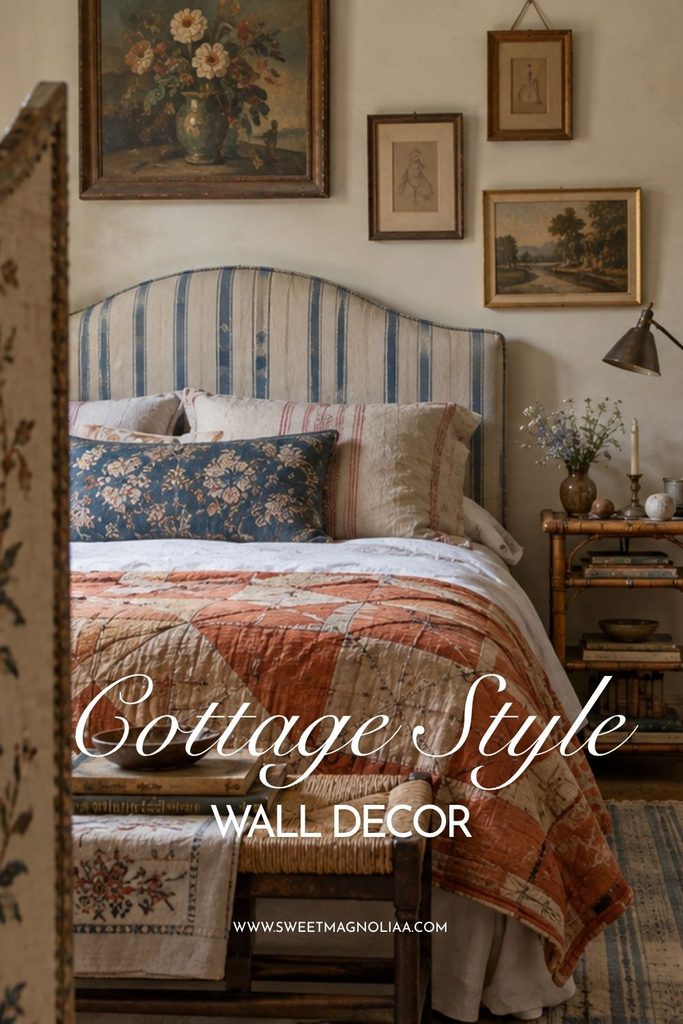
Look for small landscapes featuring rolling fields, country lanes, cottages, woodland scenes, grazing animals, gardens, rivers, and distant hills. Vintage-inspired oil paintings work particularly well because their muted colors bring warmth and age to the room.
Instead of choosing artwork from one matching collection, mix different sizes and subjects.
Warm wooden frames, antique gold, aged brass, and darker timber can help connect the pieces without making everything identical.
Try placing one larger countryside landscape near the center and allowing smaller paintings to gather around it.
The finished gallery wall should feel discovered rather than designed all at once.
2. Decorate With Botanical Prints
Botanical art brings the garden indoors, making it particularly suited to cottage wall decor.
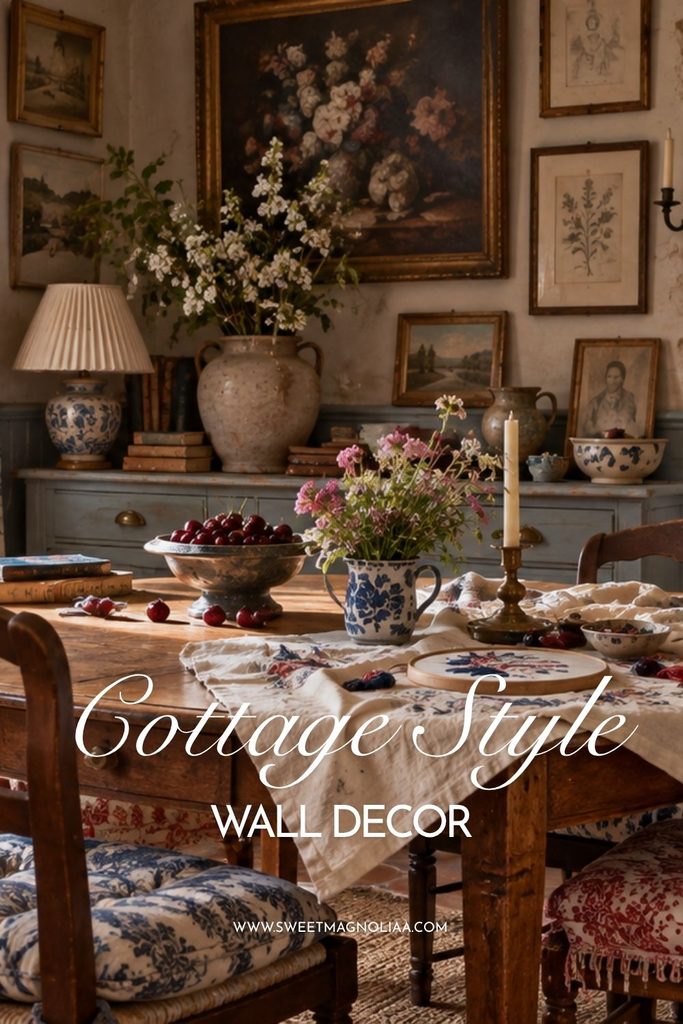
Vintage flower illustrations, herb studies, fern prints, pressed flowers, garden sketches, and botanical watercolors can all work beautifully.
You could create a full botanical gallery wall or use several botanical pieces alongside landscapes and other vintage artwork.
For a softer cottage look, choose prints with cream, parchment, or gently aged backgrounds instead of stark white.
Wood, antique brass, faded green, cream, and slim gold frames can complement the botanical theme without distracting from the artwork.
A botanical display is especially lovely in bedrooms, kitchens, garden rooms, hallways, and breakfast nooks.
3. Build a Romantic Floral Art Wall
For a softer interpretation of cottage style, dedicate a wall to flowers.
Combine rose paintings, loose floral watercolors, vintage flower prints, small still-life paintings, botanical sketches, and perhaps a piece of floral embroidery.
A gentle palette can help varied artwork feel connected.
Dusty rose, muted burgundy, cream, faded peach, soft green, and touches of blue all work beautifully in romantic cottage style homes.
Mix larger paintings with smaller pieces rather than using artwork of identical dimensions.
The variation creates movement and makes the collection appear as though it has grown gradually.
This type of wall decor works particularly well in bedrooms, reading corners, dressing areas, and cozy sitting rooms.
4. Gather Vintage-Style Oil Paintings
Cottage walls do not always need to feel pale and delicate.
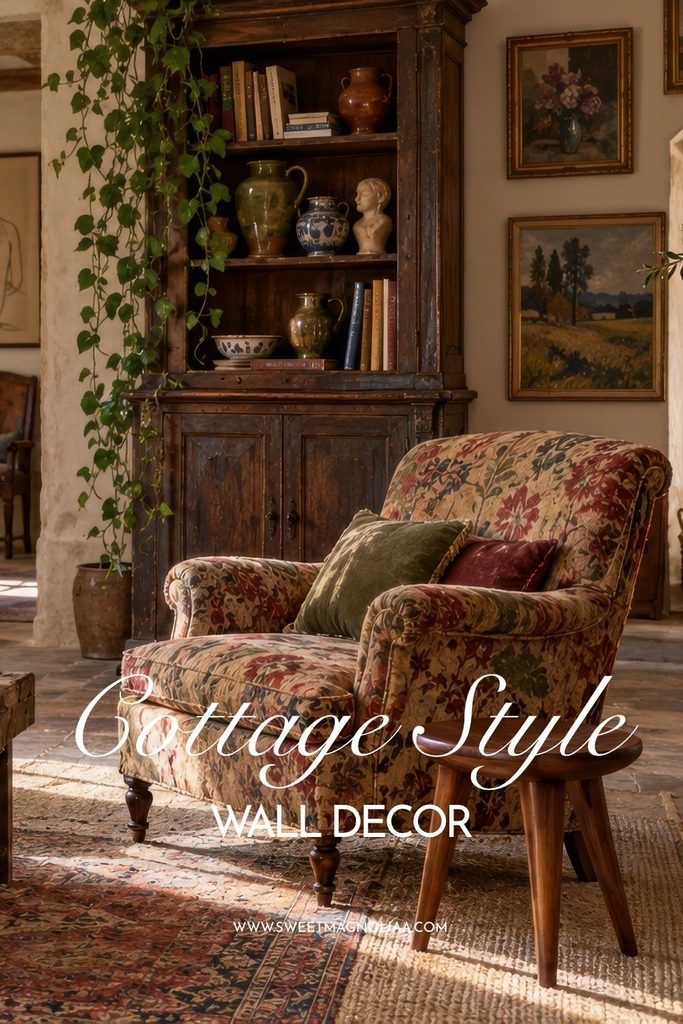
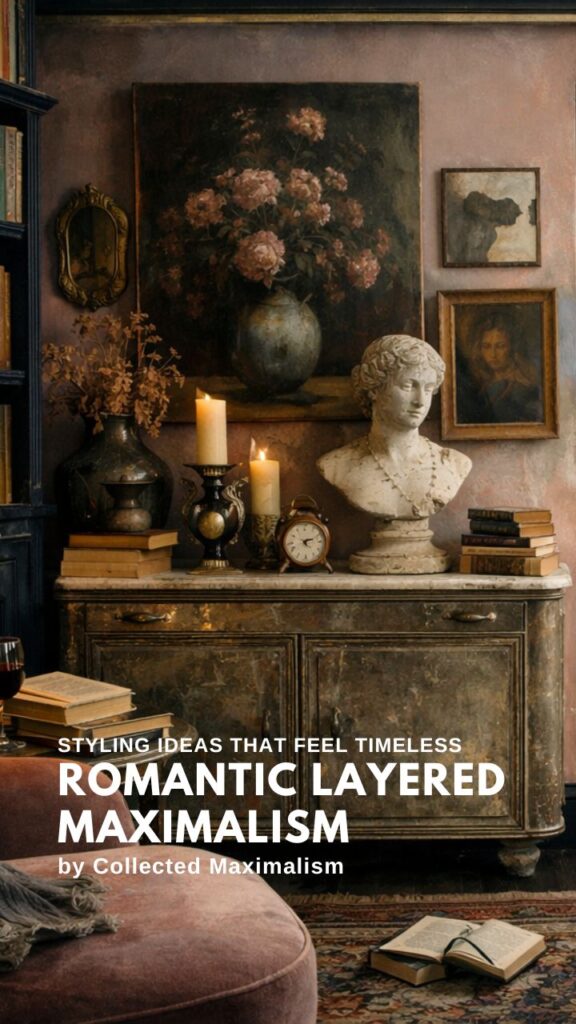
A collection of vintage-style oil paintings can introduce depth, richness, and a subtle touch of maximalism.
Mix landscapes, portraits, still lifes, flowers, animals, seascapes, and architectural scenes. Some paintings can be light and romantic, while others can bring deeper greens, browns, burgundy, and gold into the room.
Frames can vary too.
Carved gilt frames can sit beside dark wood, painted timber, and simpler antique-style frames.
This approach is especially effective above a sofa, fireplace, console table, or old wooden chest.
The goal is not historical accuracy. It is to create a wall that feels layered with art collected across different moments in time.
5. Create a Blue-and-White Cottage Wall
Blue and white is a timeless combination for cottage style homes.
Rather than limiting the idea to framed artwork, combine several kinds of wall decor.
Blue-and-white landscapes can sit beside botanical prints, transferware plates, small ceramic pieces, sketches, and an antique mirror.
Dusty blue, faded indigo, soft cream, and warm white create a gentle foundation, while aged wood and brass prevent the arrangement from feeling too crisp.
This is a lovely option when you want a collected wall that still has a recognizable color story.
Use it in a living room, dining area, bedroom, kitchen, or hallway where the blue can repeat elsewhere through cushions, ceramics, curtains, or upholstery.
6. Make a Vintage Plate Wall
Not all wall decor needs to be framed.
Decorative plates are one of the easiest ways to bring pattern, color, and shape to cottage walls.
Collect floral china, transferware, botanical plates, small saucers, decorative platters, and vintage-inspired ceramics.
They do not need to come from the same set.
Instead, look for a common thread such as blue, green, burgundy, pink, or a recurring floral motif.
A plate wall can sit above a kitchen dresser, dining-room sideboard, breakfast table, or console. Plates can also climb vertically beside a doorway or fill a narrow section of wall where framed artwork might feel awkward.
Use secure plate hangers suited to the size and weight of each piece.
The different shapes add dimension and keep the display from feeling like a traditional gallery wall.
7. Create a Family Heirloom Gallery Wall
Some of the best cottage wall decor cannot be bought at all.
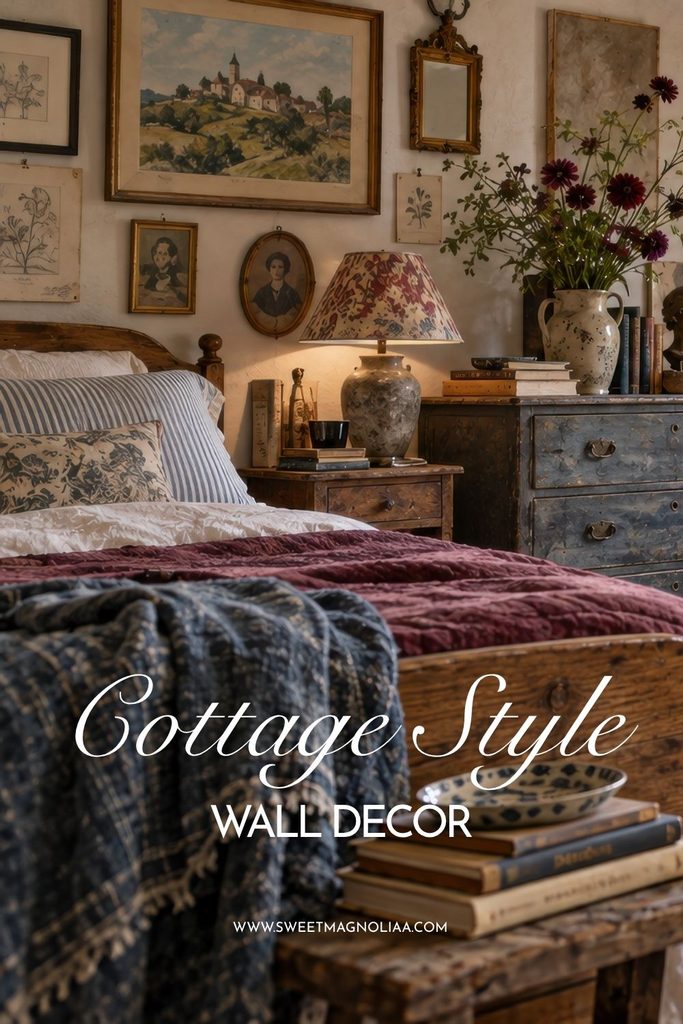
Family photographs, handwritten letters, recipes, postcards, children’s artwork, silhouettes, wedding photographs, old documents, and inherited pictures can become part of a deeply personal gallery wall.
Try combining different generations rather than keeping every photograph from the same period.
An old black-and-white portrait might sit beside a handwritten recipe. A wedding photograph could be paired with pressed flowers or a tiny landscape.
Frames can also evolve over time.
Wood, brass, cream, black, and antique-style frames can coexist when a few finishes repeat throughout the arrangement.
Most importantly, leave space for the collection to grow.
A family gallery wall becomes more meaningful when new memories are allowed to join older ones.
8. Decorate With Vintage Mirrors
Mirrors are another beautiful alternative to traditional framed art.
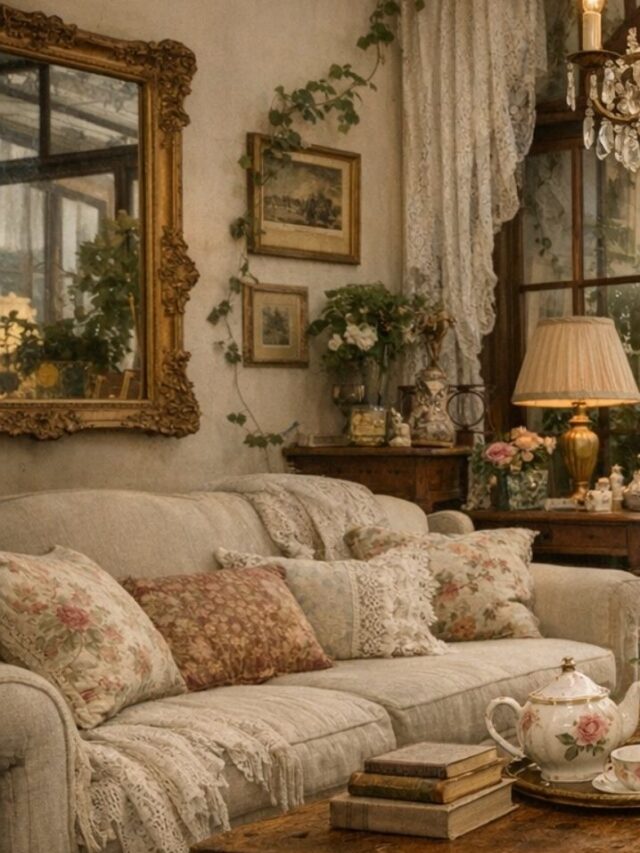
For cottage style homes, look for oval mirrors, small rectangular mirrors, arched shapes, scalloped edges, distressed painted frames, warm wood, antique brass, and aged gilt finishes.
You could create a small collection entirely from mirrors or mix 2 or 3 into a larger gallery wall.
This works particularly well in smaller rooms because mirrors reflect windows, flowers, lamps, artwork, and other parts of the interior.
Try hanging a group above a console or dresser, or use one larger vintage mirror as the anchor for smaller artwork.
The reflective surfaces introduce light while the varied frames add the sense of age and character associated with cottage interiors.
9. Let Artwork Grow Around Bookshelves
A cottage gallery wall does not need to occupy one perfectly empty rectangle.
Some of the most interesting arrangements interact with furniture and architecture.
Hang small paintings above a bookcase. Place a tiny portrait in the narrow section of wall beside it. Lean framed art directly against the back of a shelf. Continue the arrangement around a reading chair or nearby doorway.
The result feels less like a formal display and more like part of the room.
This approach works particularly well in living rooms, libraries, home offices, and reading corners.
Books already introduce color, texture, and personality, so extending artwork beyond the shelves creates a beautifully layered cottage atmosphere.
10. Add Dark Academia to Cottage Walls
Dark academia can bring depth to cottage wall decor without turning the entire room dark.
Choose the elements selectively.
Atmospheric landscapes, old portraits, architectural drawings, antique maps, botanical studies, sketches, and book illustrations can introduce a more scholarly feeling.
Use walnut, mahogany, aged gold, or dark painted frames, then soften them with lighter cottage elements.
Cream plaster walls, linen curtains, floral upholstery, worn rugs, garden flowers, and comfortable furniture can balance the darker artwork.
The contrast is what makes the combination interesting.
The room remains recognizably cottage, but the wall has a richer and slightly more intellectual character.
11. Introduce French Country Wall Decor
Cottage interiors can also borrow from French country style.
Pastoral paintings, antique mirrors, botanical artwork, old engravings, decorative sconces, small landscapes, and gently ornate frames can create a slightly more refined look.
Try anchoring the wall with a larger gilded mirror or pastoral painting.
Smaller artwork can then gather around it in simpler wood and antique-style frames.
Another option is to keep the wall relatively restrained and create a composition with a painting, pair of sconces, and antique console table beneath.
The combination of rustic and elegant elements gives this style its charm.
Allow a little age and imperfection to remain visible so the room does not become overly formal.
12. Decorate Cottage Kitchen Walls
The kitchen offers some of the most interesting opportunities for cottage wall decor.
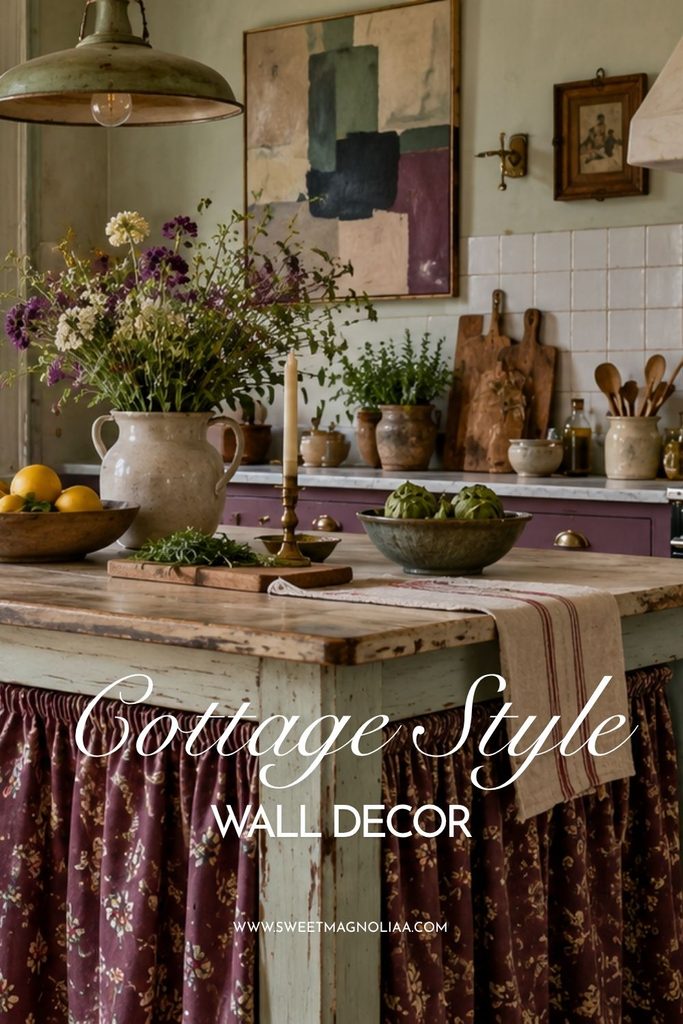
Here, useful objects can become part of the decorating.
Combine herb illustrations, fruit studies, small still-life paintings, decorative plates, copper pieces, baskets, wooden boards, old recipes, and peg rails.
A tiny landscape can hang above an open shelf. A handwritten recipe can be framed near a collection of plates. Baskets or useful kitchen tools can hang from wooden pegs.
This mixture of practical and decorative pieces makes a cottage kitchen feel lived in rather than staged.
Just keep delicate or valuable artwork away from areas exposed to excessive steam, heat, grease, or water.
13. Hang Embroidery, Needlework and Textiles
Fabric can bring another layer of texture to cottage walls.
Vintage embroidery, needlepoint, samplers, quilt fragments, small tapestries, and beautiful pieces of patterned fabric can all become wall decor.
Some textiles can be framed to protect them, while suitable decorative pieces can be displayed using other secure hanging methods.
You do not necessarily need an entire textile wall.
One piece of embroidery placed among paintings can interrupt a traditional gallery wall beautifully.
Or make a larger textile the focal point above a bed, console, or reading chair.
Textiles are particularly effective in cottage style homes because they echo the softness already found in curtains, cushions, quilts, rugs, and upholstered furniture.
14. Mix Art With Plates, Mirrors and Objects
One of the easiest ways to create a truly collected cottage wall is to stop thinking only in terms of pictures.
Begin with framed art, but introduce other shapes and materials.
Add an oval mirror.
Include a decorative plate.
Bring in a small piece of embroidery.
Use a wall sconce.
Add a tiny basket or another lightweight decorative object that can be safely mounted.
These unexpected pieces break up rows of rectangular frames and create a more dimensional arrangement.
This is also a lovely way to introduce maximalism without simply adding more artwork.
Instead of filling every available space, choose pieces that contribute a different texture, shape, color, or story.
The finished wall can feel abundant while still being thoughtfully composed.
15. Transform a Small Corner With Wall Decor
You do not need a large living-room wall to experiment with cottage wall decor.
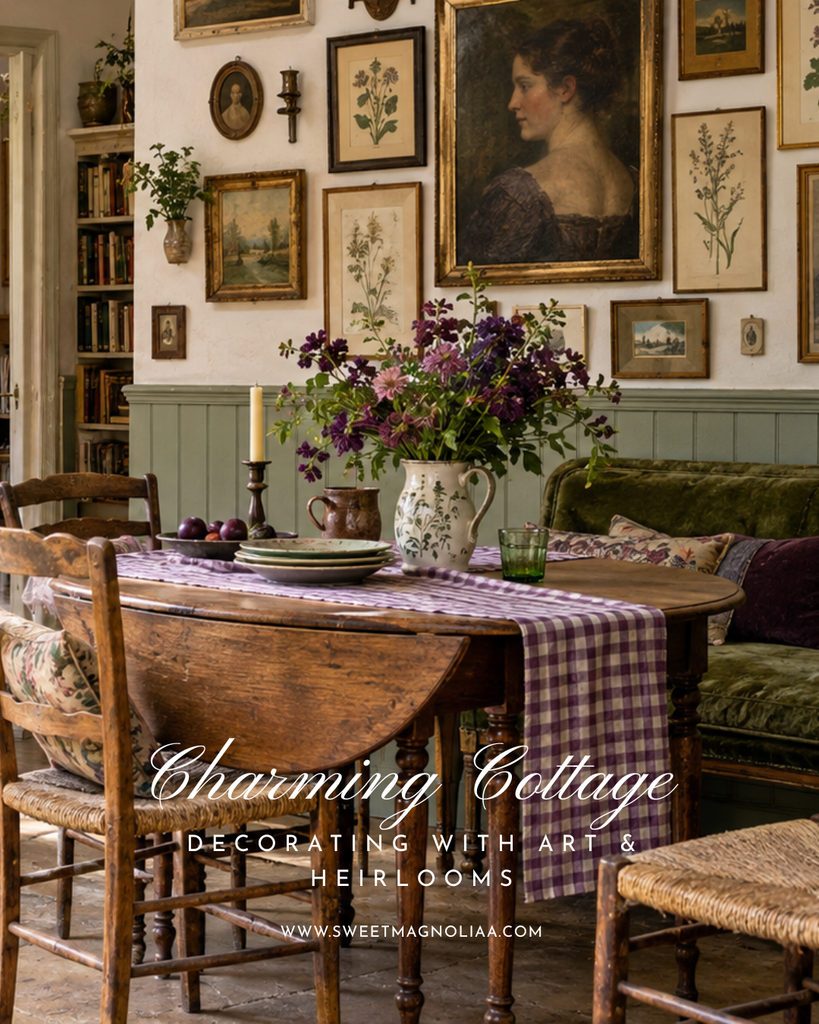
Small and awkward spaces are often some of the most charming places to decorate.
Look at the wall beside a window, above a writing desk, near a reading chair, beside the fireplace, at the end of a hallway, or around a small breakfast table.
A miniature gallery wall of 3 to 5 pieces may be all the space needs.
Try a tiny landscape beside an oval mirror. Hang 3 botanical prints vertically above a desk. Place several small paintings around a reading chair.
Because the arrangement is compact, it feels intimate rather than dramatic.
These smaller moments can also connect different areas of a cottage-style home without requiring every room to have a large statement wall.
How to Make Cottage Wall Decor Feel Collected
The beauty of cottage wall decor is that it does not need to be completed in one weekend.
In fact, it often looks better when it isn’t.
Start with pieces you already own and genuinely enjoy. Then notice what they have in common.
Perhaps you repeatedly choose landscapes. Maybe almost everything contains blue. Perhaps you are naturally drawn to botanical art, dark wooden frames, floral china, or old family photographs.
Those recurring details can become the visual thread that holds a collection together.
You can then add new pieces slowly through antique shops, flea markets, vintage markets, travels, family collections, printable artwork, and pieces discovered simply because you love them.
This is also what separates a collected cottage wall from a wall that merely looks busy.
There may be many different things to look at, but there is still a relationship between them.
Cottage Gallery Wall vs. Cottage Wall Decor
Although the terms are often used together, they do not have to mean exactly the same thing.
A gallery wall usually refers to a grouped arrangement of framed artwork, photographs, prints, or similar pieces.
Wall decor is broader.
It can include gallery walls, but it can also include mirrors, plates, baskets, sconces, textiles, shelves, architectural objects, and practical pieces.
In cottage style homes, combining the 2 approaches can create particularly interesting results.
A traditional gallery wall might become more relaxed with the addition of a small plate or mirror. A kitchen wall might combine framed botanical art with hanging baskets and useful copper pieces.
Rather than deciding whether something technically belongs in a gallery wall, consider whether it contributes to the overall story of the room.
MORE ON COTTAGE STYLE HOMES
Maximalism in Cottage Style Homes: 15 Beautiful Ideas
7 French Cottage Color Palette Ideas Beyond Sage Green
Why Sage Green Never Goes Out of Style in Interior Design
The Best Colors to Pair with Sage Green in French Cottage Interiors
English Cottage Style in a Romantic London Townhouse
10 FAQs About Cottage Wall Decor and Gallery Walls
1. What wall decor looks best in cottage style homes?
Vintage landscapes, botanical prints, floral paintings, family photographs, decorative plates, antique mirrors, embroidery, needlework, baskets, and small collected objects all work beautifully in cottage style homes. Choose pieces that relate through color, mood, material, or personal meaning rather than trying to match everything exactly.
2. What should I put on a cottage gallery wall?
A cottage gallery wall can include landscapes, botanical artwork, family photographs, floral paintings, vintage prints, sketches, pressed flowers, postcards, and small mirrors. Mixing subjects and frame styles can help the arrangement feel collected over time.
3. Do gallery wall frames need to match?
No. Mixed frames often suit cottage interiors particularly well. Try repeating 2 or 3 finishes—such as warm wood, antique brass, and aged gold—so the arrangement has variety without feeling disconnected.
4. How can I make cottage wall decor look collected instead of cluttered?
Create a few repeating visual threads. These might be similar colors, recurring subjects, related frame finishes, or a consistent sense of age. Leave some open wall around the collection as well. Maximalism does not require filling every available space.
5. Can I mix paintings, mirrors and plates on one gallery wall?
Yes. Combining framed art with mirrors, decorative plates, embroidery, and other wall decor can create a more layered cottage look. Keep framed artwork dominant and use dimensional pieces as accents if you want the arrangement to remain visually balanced.
6. What colors work well for cottage wall decor?
Cream, dusty blue, faded rose, moss green, muted burgundy, warm brown, soft ochre, and antique gold all work beautifully in cottage interiors. You do not need to use every color; repeating 2 or 3 shades from the surrounding room can help connect the wall decor to the rest of the space.
7. How do I decorate a small cottage wall?
Use a smaller arrangement rather than trying to fill the entire surface. A group of 3 to 5 pieces can work beautifully above a desk, beside a window, around a reading chair, or at the end of a hallway. Vertical arrangements are also useful for narrow walls.
8. Can dark artwork work in a cottage-style home?
Yes. Dark landscapes, antique portraits, old maps, and deeper wood frames can add contrast and depth. Balance them with softer cottage elements such as floral fabrics, cream walls, linen curtains, warm lighting, and lighter decorative pieces.
9. Where can I find affordable cottage wall decor?
Thrift stores, flea markets, estate sales, antique markets, printable art shops, vintage stores, and pieces already owned by your family are good places to start. Old frames can also be reused with new prints, photographs, botanical artwork, or personal keepsakes.
10. How do I start a cottage gallery wall without buying everything at once?
Begin with 1 larger anchor piece and a few smaller pieces you already love. Hang or arrange those first, then allow the collection to grow. Leaving intentional gaps gives you space to add future artwork, photographs, vintage finds, and meaningful objects without rebuilding the entire gallery wall.
Create Cottage Walls That Feel Like Home
There is no single formula for decorating the walls of a cottage-style home.
One room might call for an abundant gallery wall filled with landscapes and botanical art. Another may need only a vintage mirror and 3 small paintings. A kitchen could be brought to life with plates, baskets, herb prints, and copper, while a bedroom might feel complete with floral artwork and a piece of old embroidery.
The goal is not to fill every wall.
It is to create rooms where the things you choose feel connected to the life being lived around them.
Start with what you already love. Notice the colors, subjects, and materials you return to naturally. Add new pieces when you find something that belongs in the story.
Over time, the walls begin to feel less like surfaces that needed decorating and more like a record of the home itself.
And perhaps that is what makes cottage style homes so inviting: they leave enough room for beauty to be gathered slowly, one piece at a time.